

The story
The Wooden Bowl
A story about an old wooden bowl, and what it came to hold.
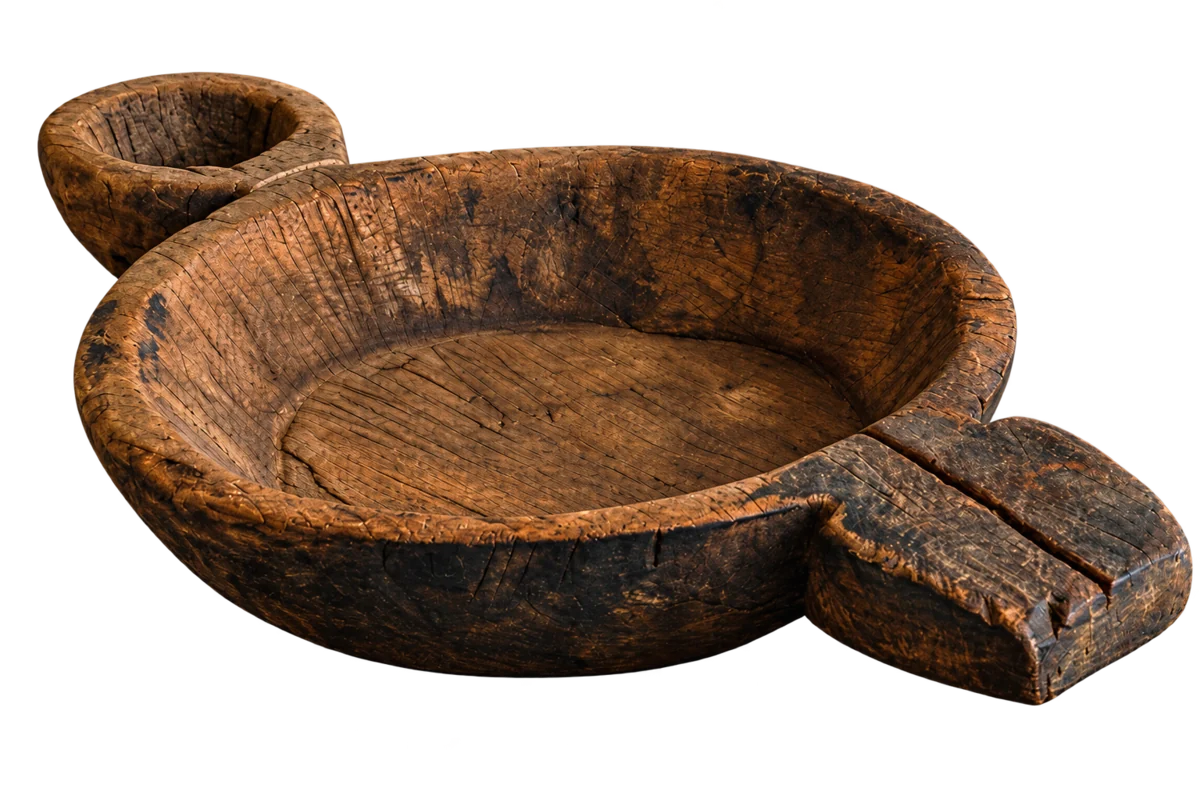
The old wooden bowl
There was once an old wooden bowl. It was not a fine bowl. Nobody had polished it until it shone, and nobody had decorated its rim with silver or gold.
It had marks where hands had held it, scratches where spoons had scraped it, and the sort of dents that come from being useful for a very long time. At first glance, there was nothing remarkable about it at all.
And when the bowl was empty, it looked emptier still. Yet an empty bowl is a curious thing. You can look into it and say, “There is nothing there.” Or you can look again and realise that everything that might one day fill it still has room to arrive.
That is where our story begins. Not with everything. With enough.
Enough to begin
There was a bench to work upon, a handful of tools, a fire to keep warm and the willingness to begin. No great treasure chest was opened, and no finished thing appeared from behind a curtain.
One small thing was made, and that small thing made it possible to make the next. The bowl began to fill.
Oliver and the bowl
Long before any of this, there was an older story about a boy and a bowl. Oliver held his out and said, very simply: “Please, sir, I want some more.”
It is remembered because the request caused such a fuss, yet there was nothing wrong with the question. Sometimes the bowl really is empty, and sometimes what is in it is not enough.
And sometimes, before asking for a larger helping, it is worth looking down and discovering that there was more in the bowl than we first knew.
The refiner's fire
Near the bowl burned a fire.
They say a refiner’s fire burns away the dross until the silver beneath can be seen. Perhaps some fires do.
But there was no silver hidden in this bowl. No gold beneath its scratches. It was wood before the fire was lit, and wood when the fire grew cold.
The fire was for the things made beside it.
What did not belong was burned away. What failed was brought back to the bench. Nothing broken was hidden, and nothing was thrown aside merely for having broken.
It was looked at. Understood. Made again. Sometimes it returned to the fire more than once.
And when the work was done, there was still no silver platter waiting at the end. Only the wooden bowl.
The Dragon and the Egg
In time, something came out of the workshop that could keep its own fire. It was a Dragon.
And Dragons, as everybody knows, lay eggs. So the Dragon laid an Egg.
The Egg was kept warm. From it came a Hatchling, young enough to stumble and strong enough to try.
The Hatchling stumbled often. That was allowed. Eventually, it Hatched.
And one day, perhaps, that Dragon would make another without needing the old workshop at all.
The proof of the pudding
There is another very old saying: “The proof of the pudding is in the eating.” It has been shortened over the years, although the old version matters.
It does not say that the pudding is good because somebody says so, or because it arrived in a beautiful dish, or even because the recipe sounds impressive. You have to eat it. Then you know.
Sometimes the pudding was good. Sometimes it was not. Sometimes it came out better than anybody expected, and sometimes a second helping was worse than the first.
Nobody scraped the bad pudding into the bin and pretended it had never been served. It stayed at the table with everything else, because that was part of finding out.
A good story does not become better by tearing out the pages where things went wrong. The failures stay at the table.
Distant kitchens
There were other kitchens, far away, with enormous ovens and clever cooks. Sometimes they made exactly what was needed, and there was nothing wrong with carrying the bowl there.
But the bowl did not belong to the kitchen. When the door closed, the bowl still belonged to the person holding it.
Room
That is why the bowl begins empty. It is not empty because something is missing, but because nobody else has decided in advance what you must put into it.
There is room. Room for what you know today, for what you learn tomorrow, for another Dragon, and for something nobody has thought of yet. And perhaps that is why an empty bowl is not really empty at all; part of its filling is the space for everything still unseen.
So there is no gold here, and there is no silver platter. There is only the wooden bowl, the fire beside it, and the simple rule that nothing is proven until somebody has tasted the pudding.
And when the bowl has given you all that it can and curiosity begins to tug at your sleeve once more, there is only one thing left to do. Hold it out. “Please, sir, I want some more.” There is no shame in asking. There never was.
The bowl may begin empty.
That does not mean there is nothing there.
There is room.
And what fills it next is up to you.